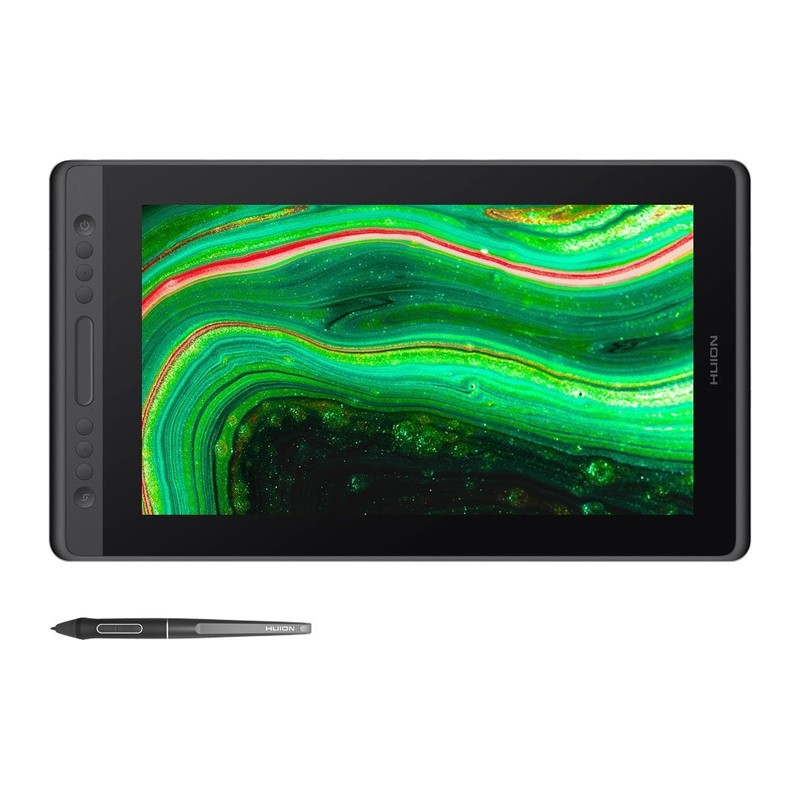
HUION Kamvas Pro 16 review: a thin 15.6-inch canvas
A fully laminated 15.6-inch pen display that's 11.5 mm thick and 1.35 kg, with a 120% sRGB panel behind anti-glare etched glass, a battery-free PW507 pen at 8,192 levels, and six shortcut keys next to a touch bar.
- huion kamvas pro 16
- HUION Kamvas 13
- XP Pen Artist 12
- Wacom Cintiq 16
Updated 2026-08-07. Interest is relative search demand (0–100), not sales figures.
HUION Kamvas Pro 16 15.6-inch pen display (GT-156) specs
| Screen | 15.6-inch IPS, 1920 × 1080 (16:9) |
|---|---|
| Active area | 344.16 × 193.59 mm |
| Pressure levels | 8,192 |
| Pen | PW507, battery-free |
| Pen resolution | 5,080 LPI |
| Report rate | > 220 PPS |
| Tilt | ±60° |
| Colour gamut | 120% sRGB volume |
| Brightness | 220 cd/m² |
| Contrast | 1000:1 |
| Screen finish | Fully laminated anti-glare etched glass |
| Controls | 6 press keys + touch bar |
| Dimensions | 437.8 × 251.2 × 11.5 mm |
| Weight | 1.35 kg |
| Connection | USB-C video interface (3-in-1 cable) |
Manufacturer's published specifications.
Verdict: the Kamvas Pro 16 is the size most artists actually want — big enough to draw a full figure without constant panning, small enough to sit on a normal desk — at roughly half what the obvious alternative costs. Lamination keeps the cursor close under the nib, the etched glass kills reflections, and the whole thing is thinner than most laptops. The catches are accessories and Mac driver polish, not the drawing.
This is an editorial summary built from HUION’s published specifications and third-party reviews, not a hands-on test.
The specs that matter
Per HUION’s official specifications:
- 15.6-inch IPS at 1920 × 1080, with a 344.16 × 193.59 mm active area, fully laminated under anti-glare etched glass.
- 120% sRGB gamut volume, 220 cd/m² brightness, 1000:1 contrast and 89°/89° viewing angles.
- PW507 battery-free pen: 8,192 pressure levels, 5,080 LPI, >220 PPS and ±60° tilt, with a 10 mm sensing height.
- Six programmable press keys plus a touch bar.
- 437.8 × 251.2 × 11.5 mm and 1.35 kg.
- USB-C video interface, driven through HUION’s 3-in-1 cable.
What reviewers love
- It’s genuinely thin. 11.5 mm and 1.35 kg is slim for a 15.6-inch pen display, and the matte metal back reads more premium than the price.
- Lamination does its job. Reviewers measured minimal parallax — the gap between nib and cursor that makes cheaper displays feel indirect.
- Colour above the class. Independent measurement put it around 96% sRGB with brightness ahead of the non-Pro Kamvas 16.
- The pen is the strong part. Smooth pressure transitions and consistent tilt across Windows and macOS come up in review after review.
- Price against the obvious rival. It has spent its life positioned as the cheaper answer to Wacom’s 16-inch Cintiq, and that comparison is most of why it still sells.
Worth knowing before you buy
- The stand situation varies. Some bundles include the adjustable stand and some don’t; ergonomics at this size need one either way.
- Mac driver quirks. The touch bar defaults to scrolling and can’t be remapped on macOS per reviewers, with occasional detection hiccups.
- Six keys, not fourteen. The cheaper standard Kamvas 16 actually carries more shortcut buttons; the Pro spends its budget on the panel instead.
- Slight parallax remains at the edges even with lamination — better than unlaminated, not literally zero.
- 1080p on 15.6 inches. Sharp enough for drawing, but if you want pixel density for fine detail, the newer 2.5K Kamvas Pro line is the upgrade path.
Who it’s for
The artist ready to move up from a screenless tablet or a small display to a full-size canvas, who wants laminated glass and a proper anti-glare surface without paying flagship money. Good for illustration, comics, animation clean-up and photo retouching where the size of the drawing surface matters more than the last few percent of colour accuracy.